Let's Look At Boundless
A brief overview of the world and the ruleset

This article will cover the up-and-coming TTRPG Boundless, developed by Fari RPGs. RP @farirpgs was kind enough to give me access to the pre-release material upon which the following information is based. The game is scheduled for release on BackerKit on the 2nd of February 2027.
Any errors in the article fall squarely on my shoulders alone.
Overview
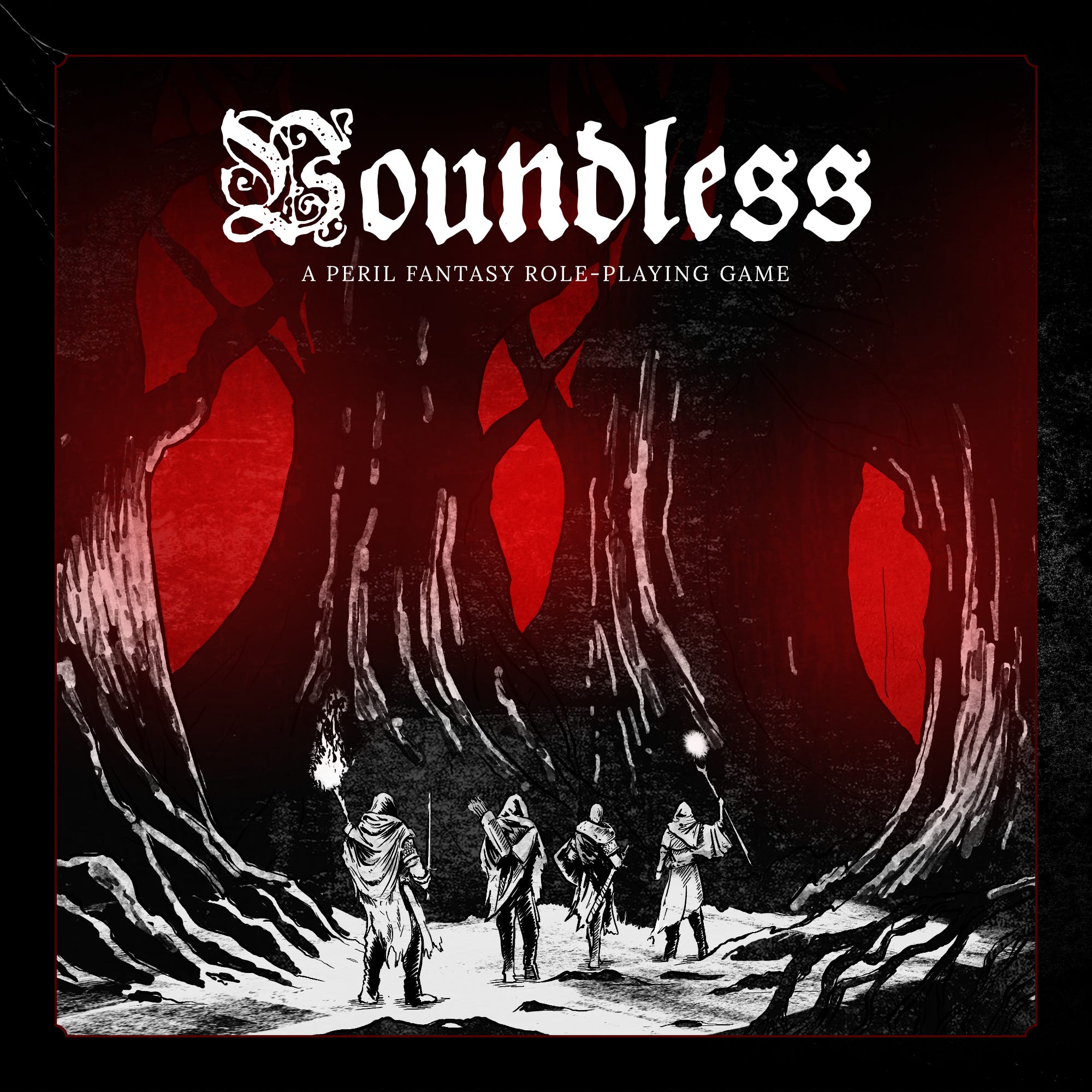
For those (like me) unfamiliar with Boundless, a brief primer: initially, there was the system called Boundless, and the first game in the series to actually see the light of day wasn't Boundless itself—despite lending its name to the whole system—but a different game called Voidlight.
In contrast to that game, this is not a sci-fi delve type of game, but more a grimdark, fantasy “soulslike.” Having recently read through both this ruleset and Odinson’s Wenderweald, I could not help but draw some parallels between the two; they share some DNA but are different enough to stand on their own legs.
The first thing that jumped out at me was that immediately after the front page, you're greeted with the Equipment pages—tables of weapons, armor, and items, prices included. That raised a question of its own: unfamiliar with Boundless, I had no idea what '1D+1' meant in the damage column. Turns out the book's dice notation is just number+D, meaning that many d6—1D is 1d6, 6D is 6d6, and so on (the game only ever uses d6s, so it doesn't bother spelling that out). 1D+1, then, is 'roll 1d6, add 1.' None of that is explained before this point, so a first-time reader is left guessing. Separately, I asked the developer why Equipment comes before even character creation, and he said it's an homage to old-school games that put inventories you can buy/find up front for quick reference. I don't have the nostalgia for those games to fully buy the reasoning, but it's a minor thing.
Next up comes the background story of the game, which is presented in ten small paragraphs, sprinkled on top of some gorgeous art—if you’re familiar with Darkest Dungeon and like that art style, this will be right up your alley. I did print the A5 booklet version and stapled it but I’ll be honest—the number of pages was at the highest limit to be doable and its use of all-black pages with white text here and there is probably not the most printer-friendly thing ever. It does, however, make for a very nice looking rulebook. The whole book is mostly black and white with hues of grey and red highlights.
Ah, yes, the story. Basically ever since the birth of the world, there have been spirits in it, that some people mistook for gods. The Church of the One Light didn’t like that, so they waged war upon the spirits, and infiltrated their realm, destroying them. Or so they thought. The spirits’ essence spread through to “our” side, and infiltrated every nook and cranny, and common folk would start to harvest the essence to use for magic.
The church, worried they were losing their grip on the common folk, deemed use of magic a Divine Right, and branded anyone else caught using it as heretics, and proceeded to torture and kill them.
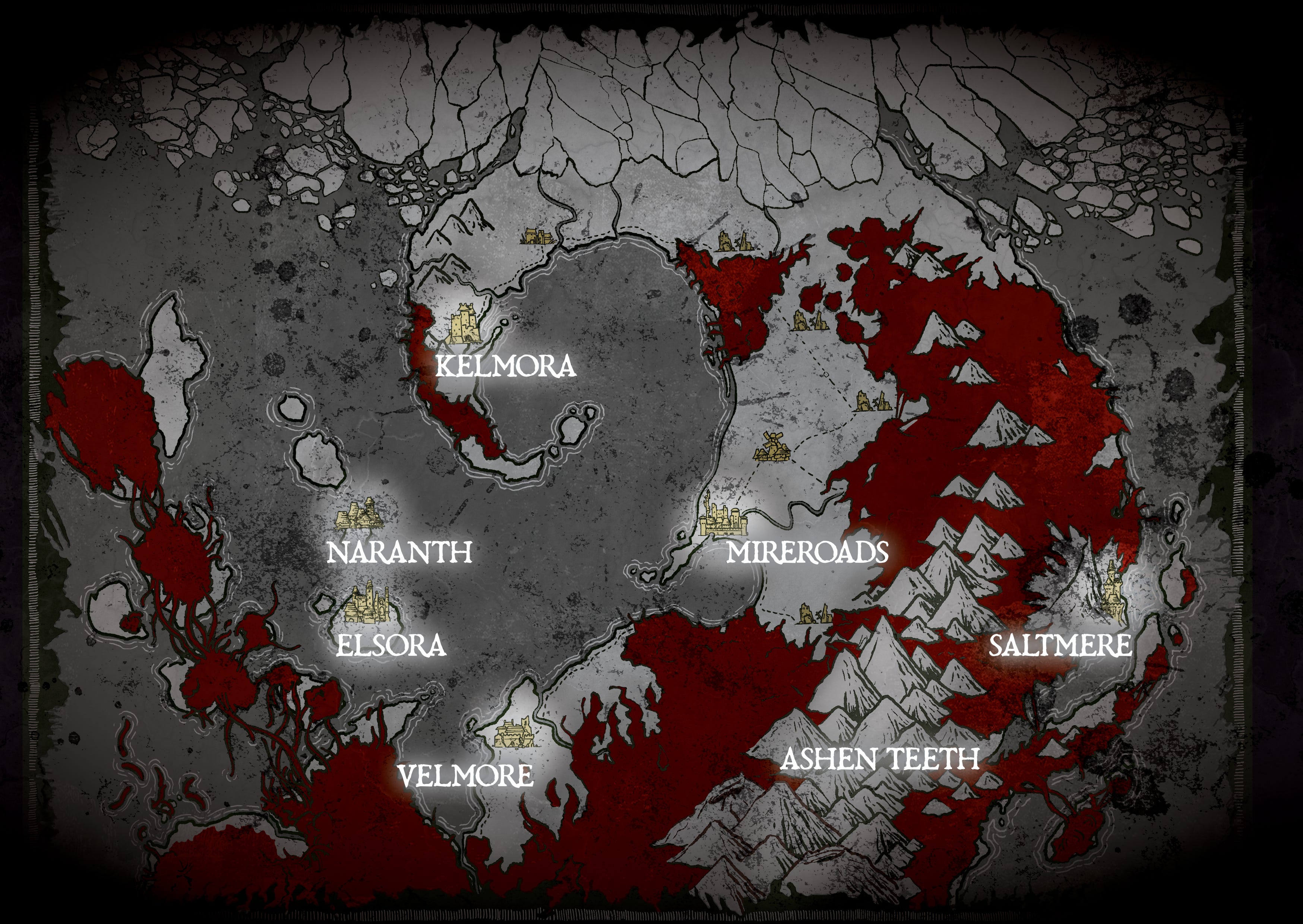
Eventually, the veil between the worlds tore again, in Derweald this time, which is where the game takes place. There’s fungal growth that spreads like cancer through the world, and most of the known land is already uninhabitable because of it. People who get caught in it get turned into wooden husks, who, without a will of their own, march towards the remaining bastions of warmth and light.
But hidden among the roots lie vaults, filled with ancient knowledge, countless treasures and artifacts. People risk their lives to venture inside in search of some valuables to get a better grip on life. Some never return. Those that do have lost parts of themselves to the woods.
Systems overview
The game runs on a d6-based system using so-called pools. For example, when you create your character, you distribute the values 1 through 4 across four different stats. Let’s say you put 4 into Strength. That means, for any Strength check, you have a pool of 4 dice. 5s and 6s are considered hits, and you count successes. As an Ironsworn nut, I will of course compare to that—2 hits count as a “Strong hit”, with additional hits making it even stronger. 1 hit is basically a “Weak hit”—you succeed but at a cost. And 0 hits is, well, a miss.
In addition to that you have what’s called Positions that modify the “hit threshold”. For example, if your character has a clear advantage when trying to do something, they’ll hit on a 4+ instead of a 5+. They’re considered to be in a “Good” position. Conversely, being in a “Bad” position is like having disadvantage—only 6s count as hits. You can go beyond that to Absolute (no need to roll, automatic success) and Impossible (you can’t even try).
On the pool subject, you have more pools, such as Usage pools for items. They abstract the amount of an item you have (let’s say torches). Whenever you figure you’d consume one of them, you roll the entire pool, and remove all misses (though a maximum of 2, never more). So let’s say you have D6 Torches. You’d roll 6d6, and get a 5,6,1,3,2,5. That means you’d subtract 2 Torches from your inventory, and next time you consume a torch, you’d roll 4d6.
You can also use pools as Tension clocks (though in the rules they’re called Event pools). Once the pool is out of dice, the event triggers.
On the subject of inventories, you have 10 inventory slots, though this can be expanded by backpacks or similar. Most items take up 1 slot, some bigger ones might take 2. But what really stood out to me was that any statuses you incur will be added to your inventory, taking up a slot. If you don’t have a slot available, too bad—you got to drop something else to make room for the status.
Speaking of statuses, you can choose to “push” a roll, rerolling all misses at the cost of adding the Fatigued status to your inventory. Statuses can only be removed by performing a remedying action in the fiction. For example, you could Rest to clear a Fatigued status, or spend a night near a campfire to clear a Chilled status.
Resting can be done either in a Short (10min) version or a Long (8h) one. A Short rest has you recover d6 HP, whereas a Long rest has you recover to full HP AND you get to clear a Status from your inventory, AND you can restore 1 point to any Attribute if you’ve lost any (more on that later).
Combat
Combat seems very deadly at least on paper—take this with a grain of salt, as I haven’t yet played the game. But basically you roll for initiative when the combat starts, then you take turns hitting each other. There’s only a damage roll—your weapon does damage according to the table, subtracted by potential armor rating the foe has. Armors reduce incoming damage by (usually) 1-3. Shields can take it even further, and you can choose to sacrifice your shield to cap the incoming damage to 1.
There are rules for ranged combat, blast damage, morale and forces (clumping multiple of the same enemy type into one group). I won’t go into detail about it for now, but might do it in the playthrough if/when combat is inevitable.
There is a bestiary of 12 different monsters, and you are encouraged to come up with your own variants as well. Some of them are clearly “boss” monsters, which, similar to Soulsborne games, have multiple phases that you need to deal with.
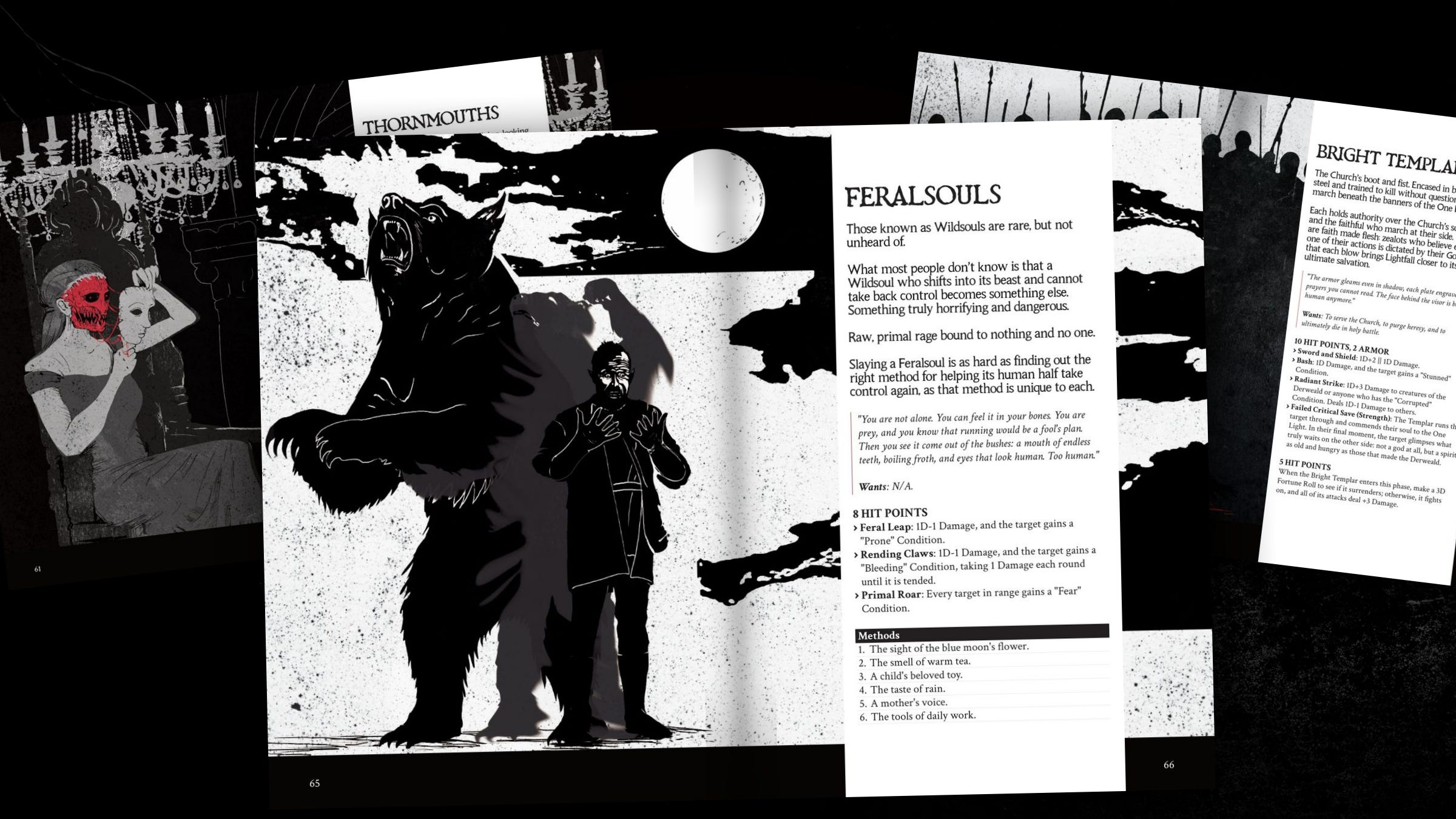
The developer has also shared a way to convert Mörk Borg monsters to Boundless, which should help expand the bestiary to fit your needs.
Character creation
The game offers a few pre-created characters for you to choose from. These are a more “heroic” type of character, as they have some Abilities that you won’t have access to if you roll up your own, custom character. Obviously you can come up with your own abilities, too, or pick and choose from the existing ones to add to your character.
As stated earlier, there are four stats, Strength, Agility, Presence and Willpower, and you’ll be assigning them values: 1, 2, 3 and 4. Those will then correspond to the pools used for checks, so if you need to lift something heavy and you have a Strength of 3, you’d roll 3d6.
Curiously, it is possible to lose even these stats—if your character runs out of HP or can’t pick another status up because their inventory is already full, they need to make a Critical Save, using the Attribute pool that makes the most sense. If they score at least 1 hit, they’re still standing, but if not, they’ll need help from someone else to recover, granted that that help is given fast enough. After rolling, you subtract 1 point from that Attribute for each miss, up to a maximum of 2. To get back those lost Attribute points, you need to do a Long Rest.
To help flesh out your character, there are 11 tables for you to get to know your character, ranging from age and physique to their local reputation, plus a bunch of tables for names divided into one for each region/city. The name tables start after the Equipment tables at the very beginning of the rulebook, which feels out of place when the rest of the character creation tables start at page 21. Minor nitpick, but still. You also get a bunch of items that have their own separate tables, one for weapons, one for armor, three distinct ones for smaller items and lastly, one for keepsakes.
HP is determined by adding your Strength and Agility together, then adding 4 to it. You also get some starting coins (1d6 * 10).
That’s about it. Now you’re ready to play. Once your character reaches a “major milestone”, they get to Advance, which means they get +2HP and +1 to any Attribute of your choice (up to a maximum of 6).
Procedures
The final thing we need to go over is the Procedures. It’s basically a framework for a structured loop that you want to perform multiple times. There’s a detailed guide on how to build your own, and then there are four examples of this: The Journey, The Delve, The Mystery and The Stronghold. Each of them has a Setup step which is done once, then one or more Actions that you can take to fill in the Progress track. Misses on actions will trigger Setbacks, and there are helpful tables with examples (or you can come up with your own, obviously).
Different actions take a different amount of time to do, and as such, there are three “types” of times: Season, Watch and Stretch, Stretch being the shortest (10min), Season being the longest (3 months) and Watch being 8 hours.
Procedure rolls (called Fortune Rolls) don’t use any set Attribute. Instead, you’ll gather a pool of dice ranging from 0-4 depending on how likely your character is to succeed at a certain action. If you’re certain they’re up to the task, you’d roll 4d6, whereas, if you’re unsure they have a snowball’s chance in hell to succeed, you’d roll 0d6 (actually 1d6 but only 6s count as hits). Then, you tally the number of hits as per usual. 2 hits or more are a “great success”, 1 hit is a “yes, but” type of deal and a miss triggers the Setback as discussed earlier.
If we take a closer look at The Journey, there are three actions you can take: Travel, Scout & Supply, and Make Camp. Out of these, Travel is the one you’d use to fill in the Progress track, and you’d usually spend a Watch traveling the lands. If they get a “great success” (2 hits or more), they get to mark 1 box of progress for each hit on the Progress track, which, by the way, ranges from 2 to 8 boxes depending on how arduous you’ve made the journey. On a “yes, but” (1 hit) they only get to mark 1 box, and they have to roll on the Setback table.
Now, the setback tables might have other types of checks involved in their results, for example, rolling a 1 on the Journey Setbacks table makes the weather take a turn for the worse, and your character will have to perform a successful Strength check or suffer the Chilled condition, or they might have gotten lost, resulting in an additional empty box being added to the Progress track.
The Scout & Supply action, then, can be used to gather ingredients and food rations etc. The way it is represented is, on hits, you get to choose from a Boons table, which either gives you additional dice to an item’s Usage pool, or extra dice to your next Make Camp or Travel actions.
Overall, even though it might sound a bit complicated as written, it’s not that hard to wrap your mind around, and I like that there’s a separate dice pool used that isn’t tied to any Attribute as such to do these moves—it’s more about how prepared you are to do them (though of course, you could argue that an old man suffering from, I don’t know, arthritis might not be as good at climbing mountains as a wiry teenage girl).
Soundtrack (yes, really)
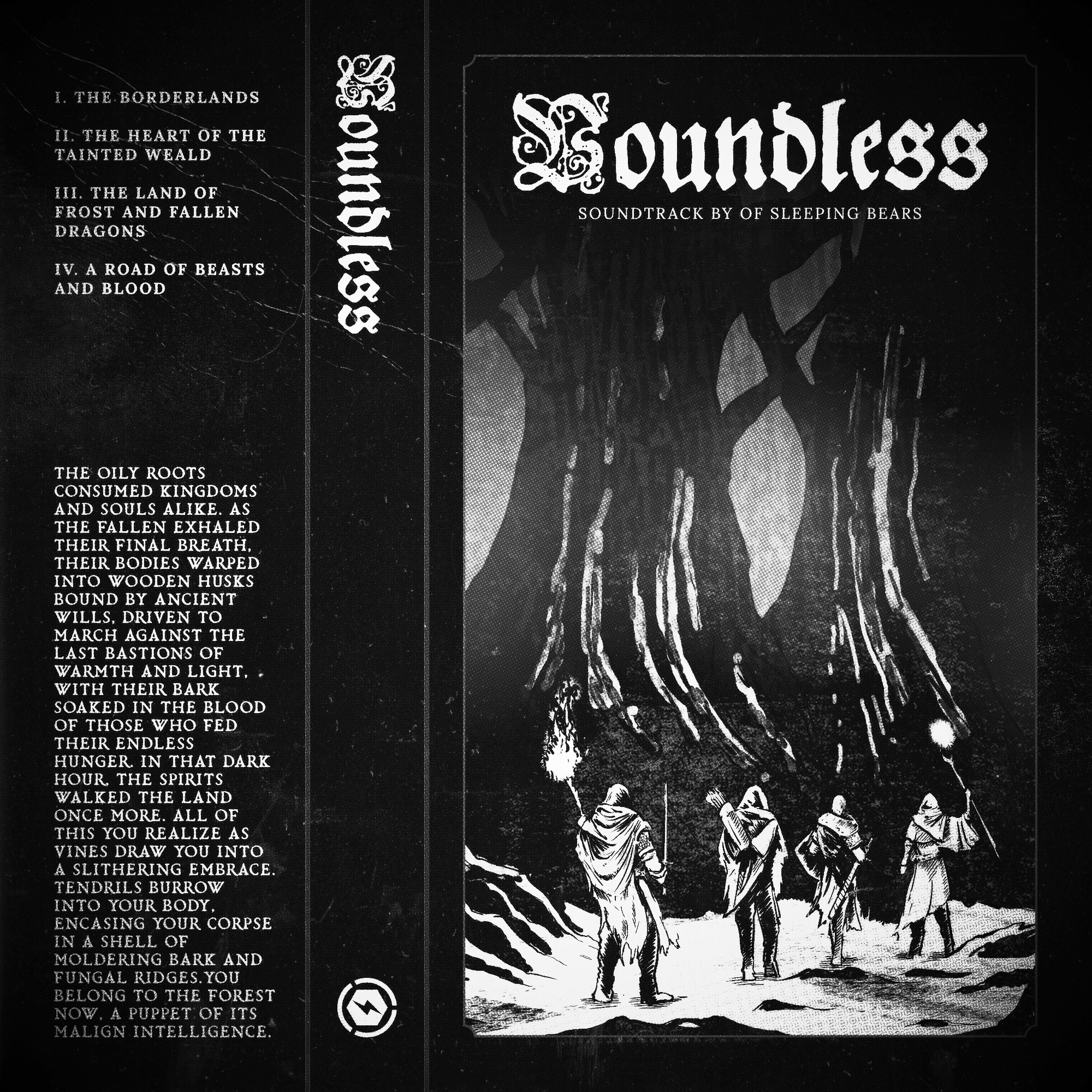
To get you in the mood, the developers have hired a band to record a soundtrack for the game. The artist is called Of Sleeping Bears and the release, aptly titled Boundless, consists of four ten-minute tracks. I highly recommend you check it out—it’s very eerie and atmospheric. If you’ve ever played the original Diablo, you’ll feel right at home.
Closing thoughts
I think that’s basically everything I wanted to cover about the game, before I dive into an Actual Play of the thing. I’ve already rolled my character, Renzo, who I will be portraying in future articles covering this game.
It is an interesting system. I was playing a pbp of it, but sadly it fell apart. Great review of the game.
I think keeping to a d6 is interesting. I find the event pools interesting instead of clunky. Yeah, usage die might be easier, but some find that clunky. Each their own I suppose.
Great overview. I think the D6 things is needlessly confusing, as simply writing 6D6 instead of D6 would be better.
The pool substituting Usage Dice sounds a little clunky, too. Why not use different dice? I get wanting to simplify the system with d6s only, but I think it backfires in some aspects.
The d6 pool for checks is really cool, though. The Procedures mechanics as well, I like that!