Let's Look At Firelights
I'm a big, big bug in a big, big world...

While I was roaming around on the Fari RPGs page searching for stuff related to Boundless (they have this wonderful bestiary and Creature Designer, check it out!), I ran into something called Firelights. Now, it’s not the first time I’ve stumbled upon it by any means, but this time, I thought I had a better grasp on their games and on solo RPGs in general, so I thought I’d give it a try.
The rulebook is a trifold pamphlet if you print it, with a cute art style. There’s also a printer-friendly option for poor people like me who don’t own color printers.
Before we proceed, I’d also like to point out that I’m not affiliated with Fari RPGs in any way, and that I bought this game with my own money.
Overview
In Firelights, you’ll be playing a sole protagonist, the last Firelight. The Beacons of Penumbra that guide the dead through the Veil have gone out, and your task is to light them again. To do this, you need to explore and find six of these Beacons scattered throughout the world.
The game is heavily influenced by Hollow Knight, one of my all-time favorite games, and names Ori and the Blind Forest as another source of inspiration, as well as the metroidvania genre at large. If you’re not familiar with metroidvania games, at the start you’re basically in a pipe with closed off branches. As you get stronger and get more items, some of those branches will open up and inside, you’ll find more items that open new branches to explore, i.e., lots of backtracking, exploring, and experimenting.
To play, you need a couple of d6 dice, a journaling book of some sort, a token, some slips of paper and a standard deck of playing cards (not including jokers).
Bugs, But No Bunny
Did I mention that your character is a bug? I did now. The similarities with Hollow Knight are hard to ignore here, and personally I was feeling like it was almost a bit too on the nose with the reference, but your mileage may vary.
The character “creation” is assigning 0, 1 and 2 to three stats, Forceful, Patient and Quick in whatever variation you’d like. These are called “Approaches.” Then, come up with a name for your bug and a pronoun. You also need to keep track of how many Treasures you have collected. Lastly, you have Fatigue, which is represented by five empty boxes that may get filled when you fail to do something.
Deal With It
The world map consists of the playing cards—you’ll draw the first one and place your character token on it. To help you get started, the pamphlet has a d66 table with four columns to flesh out your environments, set the theme and come up with NPCs. You’ve got Region, which has stuff like Glacier / Catacombs, Theme with results like War / Forgiveness, Event with Sabotage / Protect and lastly, Story with Bandit / Sage.
Once you have a good grasp on where you are, you can start exploring. But first, let me explain how the Actions work in this game—it might sound a bit complicated, but trust me, a couple of actions, and it’ll be second nature.
There’s a total of seven different Actions you can take. Most of them make use of your bug’s Approach, so let’s say that you decide to Quickly Discover a Region because you’re currently on a Glacier and it’s freezing. First, you’d draw two cards from the Story deck. Then, you’d roll 2d6 and add the value you’ve assigned to Quick to it—this is your Score. Now compare the card values individually to the Score you got (aces count as ones). If your Score beats both cards, the result is Light. If it beats one of them, it’s Shade, and if both cards are higher than your Score, it’s Darkness.
It’s going with the theme there, on the results. You are a Firelight, after all. As you might’ve guessed already, Light=good, Darkness=bad. For example, if you Confront Risk, Darkness results in you marking 1 Fatigue. I’ll explain Fatigue and the Rest action further down.
Exploring the world uses the Discover a Region action, and on a success (Light), you’ll get to add both cards to the map, and you can choose to travel to either of them. On a partial success (Shade), you get to choose which one to add, and on a failure (Darkness), you choose one of the cards to add to the map but put it face down—it’s hidden, and you need to either Confront Risk or Buy Information from an NPC to find a way to get there. On a Darkness result, you’ll also suffer 1 Fatigue. Cards that are not added to the map are discarded.
If the added card is a face card (Jack, Queen or King), congratulations! You’ve found a Beacon and can go ahead and light it. Your task is to find six of these and light them.
The card placement on the map depends on the value of the card you’re currently on—cards with higher values get placed above, cards lower in value get placed below and cards with equal value are placed next to it. The rules are quite confusing regarding this, but they say the cards should touch in the corners. I’m not sure how that’s possible with evenly valued cards, but it doesn’t have a big impact on the gameplay anyway.
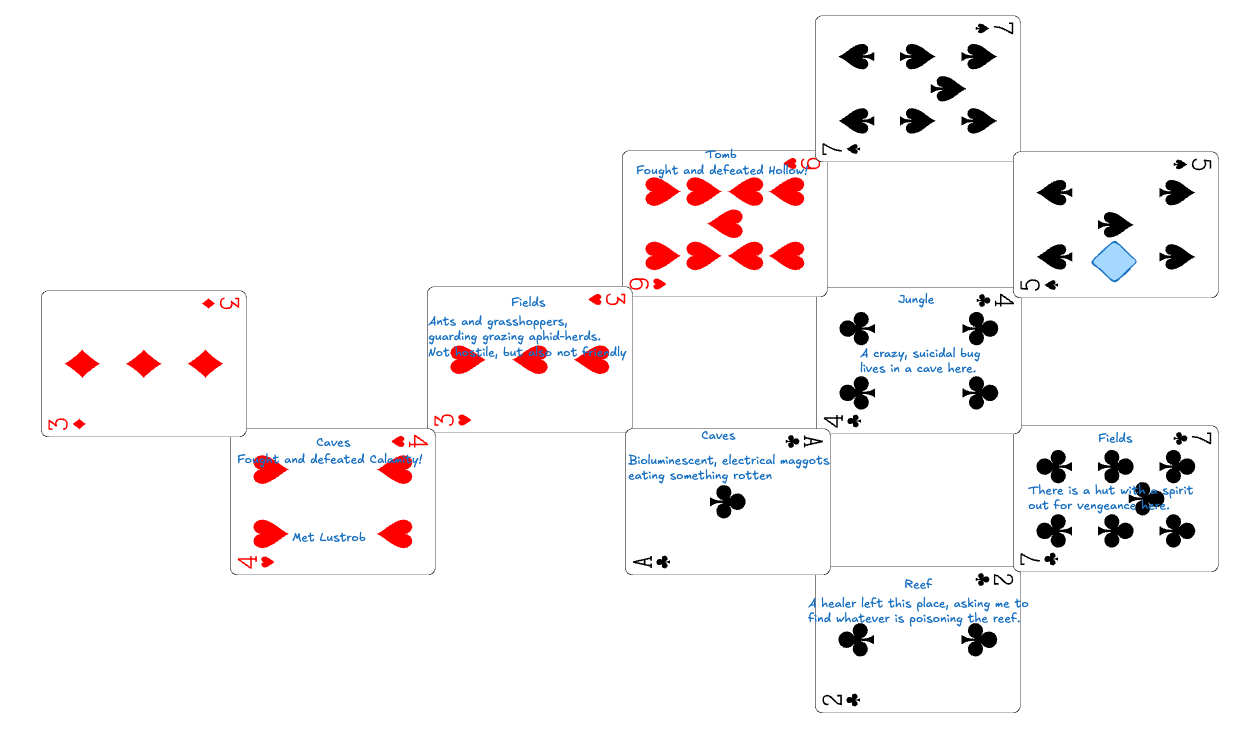
Treasures are used to trade for information with NPCs, and here, you’re not using your Approach but add any number of Treasures to your 2d6 roll instead. But to get Treasures, you first need to search for them using the Search for Treasures action, and if you’re unlucky, you might run into something really scary...
Curse You!
There are four so-called Curses in the world, of varying strength. An unwary traveler might run into these when they’re searching for treasures. You can either choose to Evade Danger or face the beast by using the Fight a Curse action.
If you choose to fight, you’ll draw two cards from the Story deck, then choose your Approach and roll 2d6 and add to your Score. Compare the values of the drawn cards one by one against your Score as per usual. However, when fighting Curses, the cards are not necessarily discarded. Instead, if you get Light (full success), you get to add both cards to the Curse’s Stack. On a Shade (partial success), you’ll get to choose one of the cards to add to the stack, and it matters which one you choose—each of the four Curses has weaknesses to certain suits; for example, Calamity is weak to Diamonds and Hearts, and each card of those suits counts as two on its Stack. If you get Darkness (fail) on your Fight a Curse, you’re then forced to take an Evade Danger action, which works exactly the same way. If you don’t succeed in Evading Danger, you’ll mark 1-2 Fatigue depending on how badly you did.
Once your Stack equals the Curse’s Strength, it’s defeated.
Fighting is a good way to cycle through your cards, as you’ll need to perform several rounds of checks, each drawing two cards from your Story deck. The strongest of the Curses has a whopping 13 Strength, so you better hope you have enough cards in your Story deck when you’re facing it.
Once a Curse has been defeated, it’s gone forever and you’ll run no risk of running into another one of its kind. It’s completely up to you to figure out which Curse you fight whenever you run into one of them.
I’m Tired, Boss
After a Curse fight, you’re probably running low on cards and/or you might have a bunch of boxes filled in on your Fatigue track. You can then choose to Rest, which empties all boxes on the Fatigue tracker and reshuffles your discard pile.
If you either run out of cards in your Story deck or your Fatigue track gets fully filled while fighting a Curse, you’ll need to flee somewhere and Rest. Any cards you’ve stacked on the Curse will remain on it and are not reshuffled into the Story deck at this point, so you can go back and finish the job later.
This is also the point where you’re supposed to scribble in your journal what you’ve been up to so far. I’m not that kind of gamer—I like to write and narrate the story as I go, so a bunch of loose actions back to back with no narration would feel weird and wrong to me.
It’s In the Cards
What would a solo RPG be without a good ol’ Yes/No oracle? This is, curiously, another Action you can take rather than just a dice roll. This is also the only other Action apart from Buy Information that doesn’t make use of your bug’s Approach. Instead, if you find the answer Likely, you’ll add +2, if it’s Unlikely, you’ll add 0, and if it is “even”, you add +1 to your 2d6 roll, and compare the Score to two cards from the Story deck. Light means “Yes, and...”, Shade means “Yes, but...” and Darkness results in “No, and...”—using the cards for this and limiting it to three possible results means you don’t have a “No, but...” outcome available.
Light or Darkness?
I’ve played a couple of sessions. Due to absolutely horrible luck with the draws, I have yet to find a single Beacon, though I’ve had mostly successes when Discovering a Region. I’ve also disposed of the two weakest Curses so far.
The gameplay is pretty good, no complaints there. The fights with Curses are probably the coolest of the mechanics. It forces you to think ahead a bit about what has been drawn and how likely you are to succeed in adding more cards to the stack.
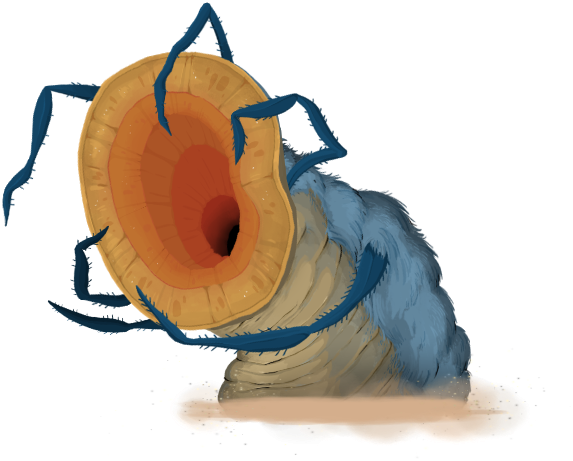
The exploration is fun, and I genuinely enjoyed the part in my playthrough where I came across a Tomb region, and foolishly decided to Search for Treasures. I pictured the area as something akin to The Abyss from Hollow Knight. Anyway, I got jumped by a ruby-eyed worm and a harrowing fight with the burrowing thing, amongst empty husks and skulls of fallen bugs, ensued. In my mind, the worm resembled The Insatiable from Slay the Spire 2.
However, I’m not really a fan of the needlessly convoluted rules for the card placement on the map—and it also kind of dictates that all Beacons will be in the northern part of the map regardless, so there’s no “reason” to hang out in the lower parts of the map. Something that could have been added to this would be that each suit had its own set of “biome oracles” to roll on. But that’s probably more due to a space constraint than anything else.
Treasures feel a bit underwhelming, especially given that they’re used to trade for information with NPCs. The only information you’re likely to want, since there’s no progression or other quests in the game, is the whereabouts of nearby Beacons. But even if you get Light as a result (”Precise information”), they won’t be able to tell you exactly where to go, because you need to have placed that face card somewhere already and it’s not a given. The only other use for it is if you’ve placed a card face down and need to find a path to that card, a scenario I haven’t run into so far in my own playthrough.
Another thing I didn’t like was that a basic Yes/No question uses up the Story deck. It’s a staple in any solo RPG, and I feel like I’m being punished for asking things about the world. Thankfully, at least the d66 Oracle rolls are “free” in that sense.
I guess to somewhat combat the use of the Story deck for the Yes/No oracle, you can basically rest at any time and it doesn’t really do anything. Which brings me to another point—there’s no real sense of danger in the game. It’s probably not the point, but I’d like there to be some kind of mechanism, a path to failure. There’s no time limit, no set amount of times the Story deck can be shuffled, nothing like that. I feel like some kind of pressure wouldn’t hurt the game.
Closing Thoughts
Even though my review might sound overly negative, all things considered, I like the game and I’m definitely pushing to finish my playthrough. If it turns out readable, I’ll probably post it here on my Substack, too.
The designer also offers an SRD of the game completely free of charge, so you can make your own vision come true, and some ideas are already percolating in my head for variants that (I think) could make for an interesting game. That alone is worth the price tag of the game.
Have you played Firelights? How did you like it? Let me know in the comments below!
This is an interesting use of cards i haven't seen before! Also makes me want to try obsidian with some plugins haha looks so handy for solo play. With the SRD, are you also making a solo game or are you expanding the player count?
Oh that's a cool compromise for people! And I love the vibe of that deck, so spooky - kind of similar to my favourite one for games, the Marigold Tarot deck, but again skeletons might creep some people out haha